KlikoAI: Difference between revisions
No edit summary |
No edit summary |
||
| (7 intermediate revisions by 2 users not shown) | |||
| Line 6: | Line 6: | ||
|Tool=No | |Tool=No | ||
}} | }} | ||
KlikoAI detects whether the paper and waste containers at NURDspace are inside or outside. Previous approaches using distance sensors (often caused spam on IRC) and BLE sensors proved unreliable (they fell right off after the container got emptied), so the project switched to AI-based vision detection instead. | |||
KlikoAI uses <code>mistral3:14b</code> via llama-swap with llama.cpp as the backend. Before that, moondream was used with inference running inside KlikoAI itself, but it struggled with certain container configurations. <code>mistral3:14b</code> showed better performance on this task. | |||
The default | It runs on gpu.vm.nurd.space (as a systemd service, in <code>/opt/klikoai</code>) on an Nvidia GeForce RTX 3080. (See https://git.nurd.space/bofh/nixos/gpu) | ||
KlikoAI uses the Home Assistant calendar integration to detect trash pick-up days and switches to a more frequent scan schedule on those days, falling back to once every 6 hours otherwise. There is also logic to detect significant changes in frame, though this has not yet been tested. | |||
State is published as an MQTT sensor to Home Assistant, which allows the "PUT THE TRASH OUTSIDE" notification to be muted for both the space's Signal group and IRC channel once the correct container has been detected outside. There is also IRC integration via the <code>!klikos</code> and <code>!klikoupdate</code> commands (the latter triggers a manual scan). | |||
A couple of bright lights controlled by an ESP8266 and a MOSFET have been added to illuminate the containers, as they sit in a fairly dark spot. As a bonus, they make for a good jumpscare when people walk past the space at night. A strobe effect has also been added for partying to gabber in the kliko corner. | |||
<gallery> | |||
KlikoAI_klikos.jpg|Klikos in their natural habitat. | |||
KlikoAI_showcasing_lights.jpg|Lights on when inference is running | |||
KlikoAI_lights_controller.jpg|ESP8266 + N-channel MOSFET controlling the lights | |||
KlikoAI_lights_and_camera.jpg|Camera and light mounting | |||
1b925f63993602e21b367f81270d818c1c4a0860b896b46ce5be2684d0a33952.png|What the camera sees | |||
</gallery> | |||
<syntaxhighlight> | |||
<@Melan> !klikoupdate | |||
<@nurdbot> [Klikos] Running kliko inference task... | |||
<@nurdbot> [Klikos] Paper: Visible Waste: Visible | Last Update: 2026-04-14 19:52:04 | Avg time: 41.48 secs | |||
</syntaxhighlight> | |||
The inference time is expected: it runs on a shared GPU machine and the model is loaded and unloaded dynamically, which is included in the total inference time. | |||
We use the following prompt: | |||
<syntaxhighlight> | |||
Look carefully at this image. | |||
I can see garbage containers. Tell me which colored LIDS are visible: | |||
1. Is there a YELLOW or cream colored lid? | |||
2. Is there a BLUE or dark blue colored lid? | |||
Reply ONLY with valid JSON using double quotes: | |||
{"yellow": true, "blue": true} | |||
</syntaxhighlight> | |||
== Previous Iteration == | |||
The original plan was to train a YOLO model on an existing garbage container dataset. Due to the limited camera mounting options at the space, detection results were poor, which led to switching to an LLM vision model. | |||
=== Dataset === | |||
The bins at NURDspace have a blue lid and a yellow lid on an otherwise green body. Finding training images with those specific lid colours turned out to be harder than expected. | |||
YOLO returns bounding boxes, so one option would have been to inspect just the top portion of the detected box and check the colour range, or determine bin position based on where it appears in frame. | |||
Since the default YOLO models do not support garbage bin detection, a custom model was trained on a 5090 using [https://universe.roboflow.com/finance-insitut/garbage-container-detection-sam7i this dataset from Roboflow]. | |||
<gallery> | <gallery> | ||
2026-01-14_17-08-31.jpg|Before training | 2026-01-14_17-08-31.jpg|Before training | ||
2026-01-14_18-02-49.jpg|After training | 2026-01-14_18-02-49.jpg|After training | ||
</gallery> | </gallery> | ||
Latest revision as of 20:08, 14 April 2026
| KlikoAI | |
|---|---|
 | |
| Participants | Melan |
| Skills | |
| Status | Active |
| Niche | Smart stuff |
| Purpose | Home Automation |
| Tool | No |
| Location | |
| Cost | |
| Tool category | |
KlikoAI Property "Tool Image" (as page type) with input value "File:{{{Picture}}}" contains invalid characters or is incomplete and therefore can cause unexpected results during a query or annotation process. {{{Picture}}} {{#if:No | [[Tool Owner::{{{ProjectParticipants}}} | }} {{#if:No | [[Tool Cost::{{{Cost}}} | }}
KlikoAI detects whether the paper and waste containers at NURDspace are inside or outside. Previous approaches using distance sensors (often caused spam on IRC) and BLE sensors proved unreliable (they fell right off after the container got emptied), so the project switched to AI-based vision detection instead.
KlikoAI uses mistral3:14b via llama-swap with llama.cpp as the backend. Before that, moondream was used with inference running inside KlikoAI itself, but it struggled with certain container configurations. mistral3:14b showed better performance on this task.
It runs on gpu.vm.nurd.space (as a systemd service, in /opt/klikoai) on an Nvidia GeForce RTX 3080. (See https://git.nurd.space/bofh/nixos/gpu)
KlikoAI uses the Home Assistant calendar integration to detect trash pick-up days and switches to a more frequent scan schedule on those days, falling back to once every 6 hours otherwise. There is also logic to detect significant changes in frame, though this has not yet been tested.
State is published as an MQTT sensor to Home Assistant, which allows the "PUT THE TRASH OUTSIDE" notification to be muted for both the space's Signal group and IRC channel once the correct container has been detected outside. There is also IRC integration via the !klikos and !klikoupdate commands (the latter triggers a manual scan).
A couple of bright lights controlled by an ESP8266 and a MOSFET have been added to illuminate the containers, as they sit in a fairly dark spot. As a bonus, they make for a good jumpscare when people walk past the space at night. A strobe effect has also been added for partying to gabber in the kliko corner.
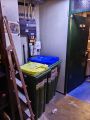
Klikos in their natural habitat.
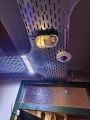
Lights on when inference is running
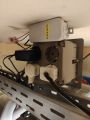
ESP8266 + N-channel MOSFET controlling the lights
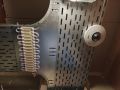
Camera and light mounting
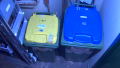
What the camera sees


<@Melan> !klikoupdate
<@nurdbot> [Klikos] Running kliko inference task...
<@nurdbot> [Klikos] Paper: Visible Waste: Visible | Last Update: 2026-04-14 19:52:04 | Avg time: 41.48 secs
The inference time is expected: it runs on a shared GPU machine and the model is loaded and unloaded dynamically, which is included in the total inference time.
We use the following prompt:
Look carefully at this image.
I can see garbage containers. Tell me which colored LIDS are visible:

1. Is there a YELLOW or cream colored lid?
2. Is there a BLUE or dark blue colored lid?

Reply ONLY with valid JSON using double quotes:
{"yellow": true, "blue": true}
Previous Iteration
The original plan was to train a YOLO model on an existing garbage container dataset. Due to the limited camera mounting options at the space, detection results were poor, which led to switching to an LLM vision model.
Dataset
The bins at NURDspace have a blue lid and a yellow lid on an otherwise green body. Finding training images with those specific lid colours turned out to be harder than expected.
YOLO returns bounding boxes, so one option would have been to inspect just the top portion of the detected box and check the colour range, or determine bin position based on where it appears in frame.
Since the default YOLO models do not support garbage bin detection, a custom model was trained on a 5090 using this dataset from Roboflow.
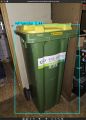
Before training
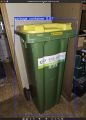
After training

